
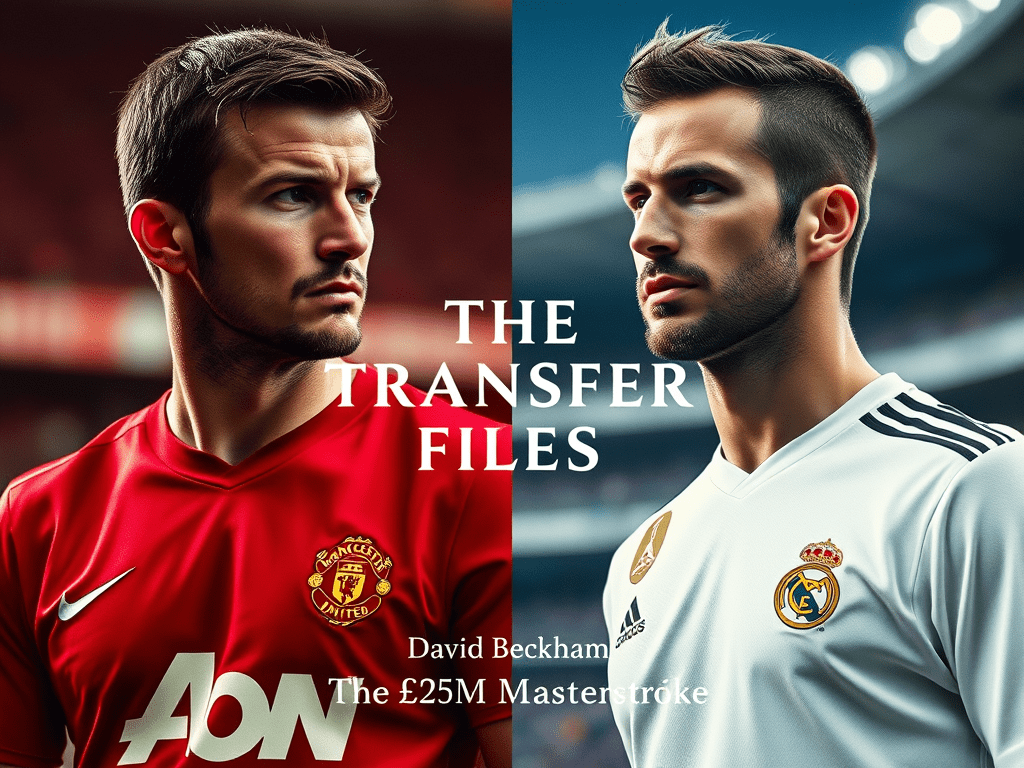
How a flying boot, wounded pride, and calculated risk created the template for modern football’s mega-deal economy
The Perfect Storm: When Personal Meets Professional
February 15, 2003. Old Trafford’s home dressing room. Manchester United had just suffered a humiliating 2-0 defeat to Arsenal in the FA Cup fifth round – a result that would effectively end their treble hopes. What happened next would change football history.
Sir Alex Ferguson, seething with rage, kicked a boot in frustration. It struck David Beckham above the left eyebrow, requiring stitches. But this wasn’t just an accident – it was the explosive culmination of a relationship that had been deteriorating for months.
The Celebrity Problem
Ferguson had grown increasingly concerned about Beckham’s transformation from footballer to global celebrity. The manager who had nurtured the boy from the academy into England’s golden boy now watched as his creation threatened to eclipse the institution itself. Victoria’s Spice Girls fame, the fashion shoots, the Hollywood lifestyle – Ferguson saw these as distractions from the singular focus required at Manchester United.
“I felt David’s work rate was dropping. His head had been turned by the interest from Real Madrid.” – Sir Alex Ferguson
The tension had been building for over a year. Ferguson noticed subtle changes in Beckham’s approach to training, his body language during team meetings, and most critically, his willingness to track back defensively during matches. The manager who had built his reputation on extracting maximum effort from every player couldn’t tolerate what he perceived as complacency from his most high-profile star.
But this wasn’t simply about work rate. Ferguson understood that Manchester United’s success depended on maintaining a delicate ecosystem where individual brilliance served collective ambition. He had managed superstars before – Eric Cantona, Roy Keane, Ryan Giggs – but each had understood that the club came first. With Beckham, Ferguson sensed a fundamental shift in priorities that threatened the very culture he had spent decades building.
Tactical Evolution and Displacement
The arrival of Juan Sebastián Verón in 2001 for £28.1 million had already signaled a tactical shift that would ultimately make Beckham expendable. Ferguson was experimenting with formations that didn’t necessarily require Beckham’s specific skill set. The 4-4-2 diamond, the 4-3-3 – systems where pace and pressing mattered more than Beckham’s metronomic crossing ability.
This tactical evolution reflected Ferguson’s broader philosophy of constant adaptation. He had recognized that football was becoming faster, more athletic, and more tactically sophisticated. The traditional English winger who hugged the touchline and delivered crosses was becoming obsolete in elite European competition. Ferguson needed players who could press aggressively, transition quickly between attack and defense, and operate effectively in multiple positions.
Beckham, for all his technical brilliance, was becoming a tactical liability in this new paradigm. His lack of pace made him vulnerable on the counter-attack, his defensive positioning was often questionable, and his reluctance to drift infield limited United’s tactical flexibility.
The Point of No Return
The boot incident wasn’t the cause – it was the symbol. Two alpha personalities, each believing they were protecting Manchester United’s interests, had reached an impasse. Ferguson saw Beckham as a distraction; Beckham saw Ferguson as holding him back from global superstardom.
What made this conflict particularly tragic was that both men were arguably right from their respective perspectives. Ferguson’s concerns about Beckham’s declining work rate and increasing celebrity distractions were legitimate. Conversely, Beckham’s frustration with his reduced role and tactical displacement was equally valid. He remained one of the world’s most technically gifted players, capable of changing games with a single cross or free-kick.
“My biggest regret in my career was leaving United for Real Madrid.” – David Beckham
But by March 2003, the die was cast. The relationship had deteriorated beyond repair, and both men knew that one of them would have to leave.
The Economic Masterstroke: Why £25 Million Was Genius
When Real Madrid’s £25 million bid was accepted in June 2003, football fans were stunned. The world’s most recognizable footballer, sold for what seemed like a bargain price? This wasn’t incompetence – it was calculated brilliance from both sides, representing one of the most sophisticated pieces of business negotiation in sports history.
United’s Strategic Calculation
Ferguson and the United board understood something crucial that escaped most observers: Beckham’s commercial value had peaked, but his football value was declining. At 28, with his pace already diminishing and his tactical fit increasingly questionable, they were selling at the optimal moment.
United’s analysis went far beyond the immediate transfer fee. They recognized that prolonged negotiations would:
- Destabilize the squad
- Create an unwanted media circus
- Potentially divide the dressing room between Beckham loyalists and Ferguson supporters
The cost of this disruption could easily have exceeded any additional transfer fee they might have extracted through harder negotiation.
More importantly, United’s leadership understood that Beckham’s presence was becoming tactically restrictive. Ferguson’s desire to implement more fluid, pressing-based systems was being hampered by the need to accommodate a player whose style belonged to a previous era of football.
Real Madrid’s Galáctico Vision
Meanwhile, Florentino Pérez harbored a vision that transcended traditional football thinking. His Galáctico policy wasn’t merely about assembling talented players – it was about transforming Real Madrid into a global entertainment conglomerate that happened to play football.
The strategy had been methodically executed:
- 2000: Luís Figo (£37 million) – establish credibility
- 2001: Zinedine Zidane (£46 million) – add artistic brilliance
- 2002: Ronaldo (£30 million) – bring goal-scoring glamour
- 2003: David Beckham (£25 million) – unlock global markets
Beckham’s signing completed this carefully constructed puzzle by unlocking the most lucrative markets of all: Asia and America, where his celebrity status transcended sport entirely.
The Commercial Revolution
The commercial returns were immediate and staggering:
Shirt Sales: Beckham’s jersey became the fastest-selling in Real Madrid’s history, with explosive sales in previously untapped markets.
Sponsorship Boom: Global brands recognized the marketing power of associating with both Beckham and Real Madrid, leading to exponential increases in sponsorship deals.
Brand Transformation: Industry analysts estimated that Real Madrid’s brand value increased by over £300 million within two years of Beckham’s arrival.
The transfer fee became irrelevant – Beckham had essentially paid for himself before completing his first training session. More significantly, the deal established a new paradigm where player transfers were evaluated not just on sporting merit, but on their potential to transform entire organizations into global brands.
Performance & Legacy: The Long Game Revealed
Initial Skepticism and Adaptation
Beckham’s arrival at the Santiago Bernabéu was met with skepticism from Spanish media, who questioned whether the English midfielder possessed the sophistication required for La Liga’s more cerebral approach. His first season yielded no trophies, leading critics to dismiss him as an expensive marketing gimmick.
But Pérez’s strategy was never designed for immediate gratification – it was about long-term transformation of both the club and the sport itself.
The Professional Reinvention
Beckham’s adaptation process became a fascinating study in professional reinvention. Recognizing that his traditional right-wing role wouldn’t translate directly to Spanish football’s more fluid systems, he gradually evolved into a more complete central midfielder.
His crossing ability remained world-class, but he developed new dimensions:
- Improved positional discipline
- Better understanding of space and timing
- A telepathic partnership with Zidane that elevated both players
By his second season, the transformation was complete. Beckham had not only silenced his critics but had become integral to Real Madrid’s tactical setup. The vindication came in 2007 when Real Madrid won La Liga, their first title in four years.
The Transfer Market Revolution
The transfer’s influence on football’s broader ecosystem became apparent as other clubs began adopting similar strategies:
Cristiano Ronaldo to Real Madrid (2009): £80 million – followed the Beckham template exactly, with massive commercial returns justifying the fee.
Neymar to PSG (2017): €222 million – designed primarily to elevate PSG’s global profile and unlock new markets.
Messi to PSG (2021): Free transfer but massive commercial coup, proving the enduring power of the Beckham model.
The Ferguson Vindication
Perhaps most significantly, the deal validated Ferguson’s decision to prioritize team harmony over individual brilliance. United’s post-Beckham era proved remarkably successful:
- Cristiano Ronaldo (2003): £12.24 million – became the world’s best player
- Wayne Rooney (2004): £25.6 million – became United’s all-time top scorer
- Three Premier League titles and one Champions League in the following years
Ferguson had demonstrated that even the most valuable assets should be sacrificed when they threaten the collective mission.
The Strategic Lessons for Modern Business
The Beckham transfer offers five key principles that continue to influence modern sports business:
1. Strategic Timing Over Maximum Price
United’s willingness to accept £25 million rather than hold out for more demonstrated the value of selling at the optimal moment rather than chasing the highest possible fee.
2. Brand Building as Primary Strategy
Real Madrid’s approach proved that transfers could be primarily about building global brands rather than just improving teams, fundamentally changing how clubs evaluate potential signings.
3. Cultural Fit Over Pure Talent
Ferguson’s decision showed that maintaining team culture and tactical coherence often trumps retaining individual brilliance, no matter how valuable that talent might appear.
4. Long-term Vision Over Short-term Results
Pérez’s patience in building the Galáctico brand demonstrated that the most successful strategies often require years to fully materialize.
5. Personal Relationships Drive Business Decisions
The breakdown between Ferguson and Beckham illustrated how personal dynamics can override rational business considerations, for better or worse.
The Enduring Impact
Twenty years later, the Beckham transfer remains the gold standard for how personal relationships, strategic vision, and commercial acumen can combine to create transformational change. It proved that the biggest risks often yield the greatest rewards, and that sometimes the most controversial decisions become the most vindicated.
For Manchester United, it marked the end of an era but the beginning of their most successful period. For Real Madrid, it validated a commercial strategy that would make them the world’s most valuable football club. For David Beckham, it launched a post-football career that has made him wealthier than his playing days ever could.
But perhaps most importantly, it showed that in modern football – as in modern business – success comes to those who can see around corners, anticipate change, and have the courage to make difficult decisions before they become obvious to everyone else.
The beautiful game had become beautiful business. And it all started with a flying boot, wounded pride, and a £25 million masterstroke that nobody saw coming.
What other football transfers would you analyze through a business lens? The intersection of sport and strategy continues to fascinate – and there are plenty more stories where personal drama meets commercial genius.
 SportsFuelr